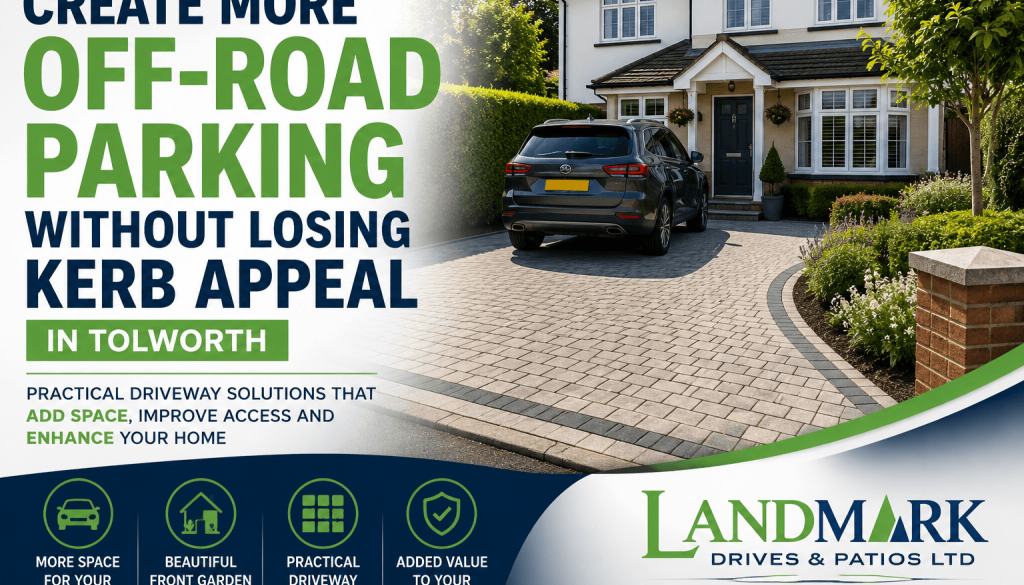
Create More Off-Road Parking in Tolworth Without Losing Kerb Appeal
Parking is one of the most practical concerns for homeowners across Tolworth and the surrounding streets of Surbiton, Berrylands, and Worcester Park. With roads busier than ever and permit zones spreading into more residential areas, having a reliable off-road space at home is no longer a luxury — for many families it is a daily necessity.
The challenge most homeowners face is not simply whether to convert their front garden, but how to do it in a way that adds real function without stripping the property of its character. A well-designed driveway can give you the parking you need and actually improve the way your home looks from the street. A poorly planned one can leave the front of the house looking flat, bare, and out of keeping with the neighbourhood.
This guide covers the key decisions involved in creating more off-road parking at a Tolworth property, from initial layout planning through to surface choice, drainage, and finishing details.
Why Off-Road Parking Matters for Tolworth Homeowners
Tolworth sits in a part of the Royal Borough of Kingston upon Thames where residential streets are busy, commuter pressure is real, and the ability to park outside your own home is not always guaranteed. For families with two cars, households with young children or elderly relatives, or anyone who has spent time circling the block looking for a space, the appeal of a dedicated off-road spot is straightforward.
Beyond convenience, off-road parking has a measurable effect on property value. Estate agents consistently report that a private driveway — particularly in suburban areas like Tolworth — is one of the features buyers look for most. It reduces daily stress, eliminates the uncertainty of street parking, and immediately increases the practical appeal of a home.
For homeowners already thinking about updating the front of their property, combining a parking solution with an improvement in kerb appeal is entirely achievable with the right approach.
Start by Assessing the Shape and Size of Your Front Garden
Before any design decisions are made, it pays to understand exactly what you are working with. Front gardens in Tolworth vary considerably — some are deep and narrow, some are wide but shallow, and many are set at an angle to the road or have obstacles such as established trees, utility covers, or existing paths that need to be worked around.
Key measurements to take before planning:
- Width of the front boundary: This determines how many cars can fit side by side and whether vehicles will need to reverse out onto the road or can turn within the plot.
- Depth from boundary to house: This affects whether a car will overhang the footway, whether there is room for pedestrian access alongside the vehicle, and whether a turning area is feasible.
- Level changes: Front gardens are rarely perfectly flat. A significant slope affects drainage design, the type of edging needed, and in some cases the finished surface level relative to the front door threshold.
- Existing features: Trees, established shrubs, boundary walls, gas boxes, and drainage gullies all affect what is possible and where the usable area begins and ends.
A realistic assessment at this stage prevents surprises later and helps ensure that whatever is installed actually works for the vehicles it needs to accommodate.
How to Add Parking Without Making the Front of the Property Look Bare
This is the concern that holds many homeowners back from converting a front garden, and it is a legitimate one. Streets where every front garden has been paved over with the same grey tarmac do look worse for it. But that outcome is not inevitable — it is the result of poor design rather than the concept itself.
The key is to think about the driveway as part of the overall front elevation of the house rather than simply as a functional surface. A few principles that make a significant difference:
Retain some green space. Even a narrow border along the boundary or a planted strip beside the house softens the visual impact of a hard surface considerably. It does not need to be large — a 60cm border with low-maintenance planting can transform how the finished result reads from the street.
Choose a surface with visual texture. Block paving, resin bound aggregate, or imprinted concrete all have far more visual character than plain tarmac. A surface with colour variation, pattern, or texture introduces interest and helps the driveway sit naturally alongside the brickwork and landscaping of the house.
Match the style of the property. A period semi in Tolworth or Berrylands will look more coherent with a traditional pattern in a warm tone than with a stark, contemporary finish. A more modern detached house might suit a clean, uniform resin bound surface. The choice of surface and colour should respond to the building, not work against it.
Choosing a Driveway Layout That Works Day to Day
Aesthetics matter, but a driveway that looks attractive and is frustrating to use every day quickly becomes a source of irritation. Layout decisions are worth thinking through carefully before work starts.
Single versus tandem parking: If the plot is wide enough, side-by-side parking for two cars is almost always preferable to one car parked behind the other. Tandem arrangements work, but they require the front car to be moved every time the rear car needs to go out, which becomes inconvenient quickly in a busy household.
Turning space: Where the road is narrow or traffic is fast-moving, being able to drive out facing forward rather than reversing blind is a significant safety benefit. If the plot has enough depth, a small turning area or a curved driveway layout can make a real difference to daily usability.
Pedestrian access: It is easy to plan a driveway that works perfectly for cars and then realise there is no clear walking route from the gate to the front door. A defined path — even just a strip of contrasting material — keeps people off the vehicle surface, reduces wear, and looks more considered.
Gate positioning: If you plan to install gates, the opening direction and the space needed to swing them affects how the rest of the layout works. Bi-fold or sliding gate options can help where space is limited.
Keeping Some Soft Landscaping for Drainage and Appearance
Retaining planted areas within or alongside a new driveway is not just a visual decision — it has practical benefits too. Plants and soil absorb rainwater naturally, which reduces the volume of surface water that needs to be managed by the driveway’s drainage design.
In Tolworth and across much of Surrey, soils tend to have a clay content that slows natural infiltration. This makes it even more important to keep some permeable, planted ground within the front boundary where possible, rather than covering the entire area with hard surfacing.
Good options for low-maintenance soft landscaping alongside a driveway include:
- Ornamental grasses and hardy perennials that need little attention once established
- Low clipped hedging along a boundary that frames the driveway without dominating it
- Ground cover plants in narrow borders that suppress weeds and require almost no maintenance
- Gravel mulch over planted beds that maintains a tidy, consistent appearance without needing regular mowing or trimming
Even a modest amount of planting makes the front of the house feel cared for and lived in, which is precisely what distinguishes a thoughtfully designed driveway from a purely functional one.
Using Borders, Edging and Patterns to Improve Kerb Appeal
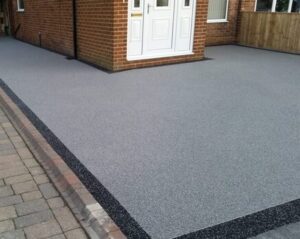
The finishing details of a driveway often do more work than homeowners expect. Edging, in particular, is one of the elements that separates a well-executed installation from one that begins to look tired after a year or two.
Edging kerbs and restraints keep the surface contained, prevent material from spreading outward, and give the driveway a defined, intentional edge. They also protect the driveway from vehicles mounting the edge repeatedly. The choice of edging material — whether a contrasting block, a bullnose kerb, or a simple flat edging course — should complement the main surface rather than clash with it.
Contrasting borders within the driveway surface itself add structure and visual interest. A different colour or slightly larger block used to create a frame or band around the perimeter of a block paving driveway is a simple detail that immediately elevates the finished look.
Pattern selection for block paving and imprinted concrete makes a significant difference to how the surface reads from the street. A herringbone pattern reads as more traditional and sits well with period properties. A running bond or stretcher pattern has a cleaner, more contemporary feel. Diagonal layouts can help a narrow driveway appear wider.
None of these details need to be complicated or expensive, but they do need to be considered before work begins, as changing them after installation is not straightforward.
Practical Surface Choices for Everyday Parking
The right surface for a Tolworth driveway depends on your priorities — whether that is appearance, maintenance requirements, budget, or planning considerations. A brief overview of the main options:
Block paving is one of the most popular choices for family driveways. It is durable, repairable (individual blocks can be lifted and replaced), available in a wide range of colours and patterns, and works well with the style of most suburban homes. Permeable block paving options also satisfy drainage requirements without needing a planning application for larger areas.
Resin bound surfacing offers a smooth, contemporary finish with a high degree of colour choice. It is fully permeable when correctly installed, low maintenance, and resistant to weeds. It suits modern properties well and is increasingly popular across the Tolworth area.
Imprinted concrete provides the appearance of stone, brick, or slate at a lower cost than the natural materials themselves. It is poured as a single slab and then stamped and sealed, making it very strong and long-lasting. The sealed surface requires periodic resealing to maintain its appearance.
Tarmac is the most budget-conscious option and is well suited to larger areas where covering the ground cost-effectively is the priority. It can be finished with a resin bound top coat for a more decorative result, or bordered with block paving for a more polished appearance.
Access, Visibility and Dropped Kerb Considerations
Creating a new driveway where no vehicle access currently exists — or widening an existing access — requires a dropped kerb. This is a separate process from the driveway installation itself and must be approved and carried out by the local highway authority.
In Tolworth, this means applying to Surrey County Council’s highways team. The application involves a site assessment to check visibility splays, road safety, and the condition of the footway. The works are then carried out by the council or an approved contractor, and the cost is met by the homeowner.
A few points worth bearing in mind:
- The dropped kerb application should be submitted before driveway work begins, as the position of the access determines where the driveway layout starts
- Visibility at the access point is assessed as part of the application — this matters on busy roads and near junctions
- On some streets, a dropped kerb may be refused if the highway conditions do not support safe vehicle access
- If a dropped kerb already exists, it still needs to be wide enough to accommodate the access you are planning
An experienced local installer can advise on whether your proposed layout is likely to be approved and help you understand the process before you commit to a design.
Common Mistakes When Converting a Front Garden into Parking
Even with a clear brief and a good installer, certain mistakes come up repeatedly in front garden conversions. Being aware of them in advance makes it easier to avoid them.
Covering too much of the garden. Maximising the hard surface area to fit as many vehicles as possible often results in a front elevation that looks stark and uninviting. A slightly smaller driveway with some planted space retained usually looks significantly better and loses very little practical function.
Ignoring the levels. A driveway that drains toward the house rather than away from it is a serious problem. Levels need to be planned from the start, not corrected after the surface is laid.
Underestimating vehicle overhang. A car parked on the driveway may extend beyond the boundary if the depth is not sufficient, potentially blocking the footway. This is a planning and safety issue as well as a practical inconvenience.
Choosing the cheapest surface without considering maintenance costs. A surface that degrades quickly or requires regular resealing may cost more over a five-year period than a more durable option installed correctly from the start.
Not thinking about gate and boundary wall integration. Removing a front wall to create vehicle access and then not replacing it with any boundary treatment leaves the front of the house looking unfinished. Gates, low walls, or planted hedging all help re-establish the sense of an enclosed, defined front garden.
When to Ask a Local Driveway Company for a Site Survey
Reading about options is useful, but there is no substitute for having an experienced eye look at the actual site. Every front garden in Tolworth is different, and what works well on one plot may not be the right approach on the next one along the street.
A site survey from a local installer gives you a clear picture of what is possible within your specific boundary, what the ground conditions mean for sub-base design and drainage, and how different surfaces and layouts would actually look at your property. It also gives you the opportunity to ask the practical questions — about access, about planning, about maintenance, about cost — with someone who can answer based on what they can see rather than general principles.
Landmark Drives & Patios offer free site surveys for homeowners across Tolworth and the surrounding areas. If you are thinking about creating more off-road parking, or simply want to improve the front of your property, speaking to a driveway company in Tolworth is the most straightforward way to move from ideas to a plan.
Get in touch to arrange a no-obligation survey and see what is possible at your property.