
Do You Need Planning Permission for a New Driveway in Guildford?
If you are thinking about replacing an old driveway or creating a new one in front of your home, one of the first questions you are likely to ask is whether you need planning permission. The answer depends on several factors — particularly the size of the area, the type of surface you choose, and how rainwater will drain away. Get these right from the start and you can avoid unnecessary delays, additional costs, or the need to undo completed work.
This guide walks through the key rules that apply to front garden driveways in England, including what applies to homeowners in Guildford, and explains why drainage and surface choice matter just as much as the planning rules themselves.
When Driveway Planning Permission May Be Needed
In England, permitted development rights allow most homeowners to install or replace a driveway without making a formal planning application — but only under certain conditions.
Planning permission is generally not required when:
- The driveway surface is permeable, meaning water drains through it naturally into the ground below
- The surface is not permeable but rainwater runs off into a border, lawn, or other permeable area on your property rather than onto the public road or pavement
Planning permission may be required when:
- You are using an impermeable surface (such as standard tarmac or concrete) over an area greater than 5 square metres
- Rainwater from the new surface would drain onto the public highway
These rules apply specifically to front gardens and forecourt areas. Driveways to the side or rear of a property are generally treated differently and are less likely to trigger a planning requirement.
It is also worth noting that some properties are subject to additional restrictions. If your home is a listed building or sits within a conservation area, you should check with Guildford Borough Council before work begins, as permitted development rights may be more limited.
The 5 Square Metre Rule for Front Garden Driveways
The 5 square metre rule is a central part of how driveway planning is assessed in England. In simple terms:
- Under 5 square metres: Any hard surface in the front garden can be installed without permission, regardless of material
- Over 5 square metres with a permeable surface: No permission needed
- Over 5 square metres with an impermeable surface: Permission is required unless water drains to a lawn or border on the property
For most properties, a driveway comfortably exceeds 5 square metres. A single car space typically measures around 14–16 square metres, which means the type of surface you choose almost always affects whether a planning application is needed.
This is why permeable surfaces have become the go-to choice for residential driveways across the UK, both to comply with regulations and to help manage surface water more sustainably.
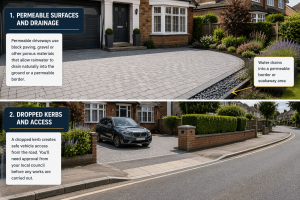
Permeable Surfaces and Natural Drainage Explained
A permeable surface is one that allows rainwater to pass through the material itself and soak into the ground beneath, rather than running off the top. This process — known as infiltration — helps to reduce the volume of water entering drainage systems during heavy rain and lowers the risk of localised flooding.
The principle behind permeable driveway design is straightforward: water falls on the surface, passes through gaps or porous material, and is absorbed by the sub-base and soil below. The rate at which this happens depends on the surface type, the sub-base construction, and the existing soil conditions.
In areas like Guildford, where clay-heavy soils are common, natural infiltration can be slower than in areas with sandy or gravelly ground. This means the sub-base design needs to account for how quickly water can disperse, which is one of the reasons a proper site survey is valuable before work starts.
Why Drainage Matters When Replacing a Driveway
Drainage is not simply a planning issue — it is a practical one that affects the long-term performance of your driveway and the condition of your property.
When an existing driveway is replaced, the drainage characteristics of the front garden can change significantly. An old cracked tarmac surface might have been allowing some water to seep through without anyone realising. Replace it with a new solid surface and suddenly all that water has to go somewhere.
Poor drainage planning can lead to:
- Water pooling on the driveway surface
- Water running toward the house foundations
- Water flowing onto the public pavement, which can create a hazard and a planning issue
- Erosion or settlement in the sub-base over time
A well-planned permeable driveway, correctly installed with the right sub-base depth and appropriate edge restraints, manages all of this from the start. It also means you are far less likely to have surface water problems during heavy rainfall, which is becoming increasingly important as weather patterns become less predictable.
What Counts as a Permeable Driveway Surface?
Several surface types are considered permeable for planning purposes. The most commonly used options are:
Gravel and loose aggregate: Water drains through the gaps between stones. Gravel driveways are cost-effective and straightforward to install, though they do require periodic raking and topping up. A good edging system and a stable sub-base help keep the surface in place.
Permeable block paving: Specifically designed pavers with gaps between them allow water to drain through into a permeable sub-base. These are a popular choice for homeowners who want the appearance of a structured, neat driveway without sacrificing drainage performance.
Resin-bound surfacing: A mixture of natural aggregate and resin that, when laid correctly, creates a porous surface. Resin-bound driveways are durable, low maintenance, and available in a wide range of colours and aggregate finishes. They are increasingly popular in Guildford because of their clean appearance and strong drainage properties.
Permeable tarmac and porous asphalt: These specialist materials look similar to standard tarmac but are manufactured to allow water to pass through. They are less widely used for domestic driveways but are a viable option in some situations.
Grass or ground reinforcement grids: Plastic or concrete grids filled with grass or gravel. These allow significant water infiltration and are suitable for lighter use driveways or occasional parking areas.
It is important to remember that labelling a surface as permeable is only meaningful if the sub-base below is also designed to handle drainage properly. An experienced installer will specify the right sub-base depth and material for your site conditions.
Do You Need Permission for a Dropped Kerb?
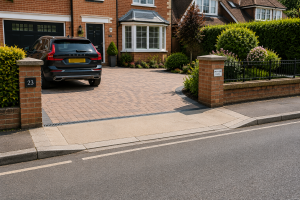
This is a question that often catches homeowners off guard. The driveway itself may not require planning permission, but if you do not already have a dropped kerb — or if you need to modify an existing one to match a new driveway position — that is an entirely separate application.
Dropped kerb installations (also known as vehicle crossings) involve works to the public highway and must be approved by the local highway authority. In Guildford, this means applying to Surrey County Council, which manages the highway network.
The process typically involves:
- Submitting an application to Surrey County Council’s highways team
- A site assessment to check visibility, road safety, and footway width
- Payment of a fee for the installation works, which are usually carried out by the council or an approved contractor
You are not permitted to carry out dropped kerb works yourself or use an unapproved contractor. Attempting to do so can result in the kerb being reinstated at your expense and possible enforcement action.
If you are planning a completely new driveway where no vehicle access currently exists, the dropped kerb application should be dealt with before driveway installation begins, as the approved access point will affect where and how the driveway is laid.
Common Driveway Planning Mistakes to Avoid
Even with relatively straightforward planning rules, homeowners regularly run into problems that could have been avoided with a little preparation. The most common issues include:
Using an impermeable surface without checking drainage options first. Standard tarmac and standard concrete are impermeable. If your front garden is large and you want either material, check whether a planning application is needed before work begins.
Assuming a new driveway will drain the same way as the old one. Replacing a cracked, deteriorated surface often changes drainage patterns. A new surface should be designed with drainage in mind from the start.
Forgetting about the dropped kerb. Installing a beautiful new driveway and then discovering the kerb arrangement is not formally approved is an expensive problem to discover after the fact.
Not checking for conservation area or listed building restrictions. Permitted development rules do not apply in the same way within designated areas. If you are unsure whether your property sits within a conservation area, Guildford Borough Council’s planning portal can confirm this.
Choosing the cheapest quote without understanding what is included. A low price sometimes reflects a thinner sub-base, minimal edge restraints, or a surface mix that will not perform as well over time. Understanding what goes into a properly constructed driveway makes it easier to evaluate quotes fairly.
Why a Site Survey Helps Before Starting Work
Planning rules provide the legal framework, but every driveway is different. The slope of the land, the condition of the existing base, the type of soil, the proximity of trees, the position of drainage gullies, and the levels of the surrounding footpath all affect how a driveway should be designed and built.
A site survey by an experienced installer gives you:
- An accurate picture of existing drainage and how it will need to be managed
- Clarity on whether levels need to be cut or built up to achieve a proper fall away from the house
- A realistic assessment of sub-base requirements based on actual ground conditions
- Guidance on surface options that will work for your specific situation
- Written confirmation of what is included in the proposed works
Without a survey, quotes are often based on assumptions. When those assumptions turn out to be wrong — as they frequently do — costs can increase, timescales slip, and the finished result may not perform as expected.
A survey also gives you the opportunity to raise the planning and drainage questions covered in this article with someone who knows the local ground conditions and can give you a clear answer based on your specific property.
Getting Advice from Local Driveway Installers in Guildford
If you are planning a new or replacement driveway in Guildford, getting advice from a local installer who understands the area’s soil conditions, typical planning considerations, and surface options is the most practical starting point.
Experienced driveway installers in Guildford can assess your front garden properly, advise on the right permeable surface for your budget and aesthetic preferences, confirm whether any planning application is likely to be needed, and provide a clear quote that accounts for drainage, levels, and sub-base requirements rather than working from guesswork.
Getting the planning and drainage side of things right from the beginning is not just about meeting regulations — it is about making sure your new driveway performs well, lasts as long as it should, and does not cause problems for your home or your neighbours further down the line.
If you are ready to move forward, booking a site survey is the logical next step. It costs nothing to have someone look at the site, ask the questions that matter, and give you an accurate picture of what is involved before any commitment is made.
FAQs